Pierre Favre - Memoriale
| F.C. 1042 | Other Manuscripts | Bibliography |
|---|---|---|
|
|
|
|
Introduction
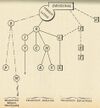
During the 20th century, many editions and translations of the Memoriale were published.[2] Most of these publications have been based on the critical edition of the text published within the Monumenta Historica Societatis Iesu in 1914.[3] Since that year, other manuscripts containing the Memoriale have been discovered. A more recent survey of them was done by Michel de Certeau, who in 1960 recorded 15 manuscripts of the Memoriale and for the first time tried to build a stemma codicum.[4]
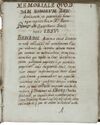
In 2018, more than 50 years after the de Certeau's work, a previously unknown manuscript of the Memoriale was discovered in the Historical Archives of the Pontifical Gregorian University (shelf-number FC 1042). This manuscript seems to be a very old testimony of the Memoriale and, above all, is one of the few manuscripts containing the whole text.
With the Pierre Favre collection, our aim is to produce a digital edition of the manuscript FC 1042. A digital reproduction of the manuscript has been made and uploaded to GATE: it is available at this link.
A full transcription of the manuscript is available: the text has been collated with the canonical one - published in 1914 in the Monumenta Historica Societatis Iesu - in order to highlight all the variants. During this work, a critical commentary was added to the transcription.
This project is also intended as a chance to create a permanent Pierre Favre 'workshop', to gain a deeper insight into his works and time. For this reason, we have also set up a Pierre Favre bibliography, where all the publications about him will be recorded: the bibliography will become the starting point for any future research about Favre and his Memoriale.
Il codice FC 1042
Formato
Manoscritto di piccole dimensioni (137 x 105 mm), in formato ottavo antico (filoni verticali, filigrana lato superiore delle carte verso il centro).
La rifilatura nei margini ha ridotto le misure del formato originale e ha eliminato parti della numerazione coeva presente nella parte superiore.
Questo formato, facile da trasportare, è tipico dei libri di preghiere già in epoca medievale con i Libri d'ore.
Cucitura
Cucito su due nervi in ... segue una cucitura alternata. Presenta capitelli in pelle allumata ancorati con catenella al dorso e passanti nei piatti per l'ancoraggio del corpo libro.
Legatura
Rilegato con una pergamena di riutilizzo manoscritta. Link (accesso riservato).
Il riutilizzo di materiali come la pergamena è pratica consueta e riscontrata in diversi esemplari conservati in APUG.
In fase di legatura, al primo fascicolo ne è stato anteposto, un'altro di otto carte interamente bianche che presenta una filigrana non identificata (una stella o due stelle a sei punte inscritta in uno scudo sormontato dalla lettera M).
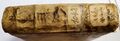
Dorso
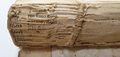
Dorso int.
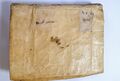
Piatto ant.
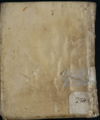
Piatto post.


Fascicolazione
Il codice è composto di 32 fascicoli regolari di 8 carte ciascuno realizzati con carta di produzione italiana, databile nell'ultimo decennio del Cinquecento, con filigrana (stella a sei punte inscritta in un cerchio sormontato da stella più piccola a sei punte[5]). Tutti i fascicoli presentano una segnatura numerica (A-Hh/8) apposta dalla medesima mano sulla prima carta del fascicolo. L'ultima carta del fascicolo Hh risulta incolla alla pergamena facendo funzione di controguardia.
Scrittura e mani

Le diable archiviste
Queste note sono un primo risultato del seminario dedicato all'edizione del Memoriale di Pierre Favre realizzata da Michel de Certeau (2025).
- Uno dei luoghi comuni più triti di celebrazione dei “classici”, che finisce per relegarli in un vuoto limbo, fuori del tempo e dello spazio, […] consiste paradossalmente nel descriverli come nostri contemporanei e nostri vicini, i più vicini dei vicini, tanto contemporanei e tanto vicini da non farci dubitare neppure per un momento della comprensione apparentemente immediata (ma in realtà mediata da tutta la nostra formazione) che crediamo di avere delle loro opere. (Méditations pascaliennes. Pierre Bourdieu)
Per seguire lo sviluppo di alcuni contenuti del seminario è possibile consultare la pagina dedicata:
Pierre Favre on the APUG blog
The Memoriale of Pierre Favre on the APUG blog
References
- ↑ In 1873 a Latin and an Italian translation of the Memoriale were published: Memoriale beati Petri Fabri primi S. Ignatii de Loyola alumni nunc primum in lucem editum a P. Marcello Bouix, Lutetiae Parisiorum, typis Alberti Gauthier-Villars, 1873; Giuseppe Boero, Vita del beato Pietro Fabro della Compagnia di Gesù primo compagno di Sant’Ignazio di Loyola, Roma, Tipografia e libreria di Roma del Cav. Alessandro Befani, 1873. In the next year a French translation was published too: Mémorial du bienheureux Pierre Lefèvre, premier compagnon de S. Ignace de Loyola. Publié pour la première fois en son texte latin et traduit en français, par le P. Marcel Bouix, Paris, Imprimerie Gauthier-Villars, 1874.
- ↑ For more information about these publications see the Pierre Favre/Bibliography.
- ↑ Beati Petri Fabri epistolae, memoriale et processus ex autographis aut archetypis potissimum deprompta, Matriti, typis Gabrielis Lopez Del Horno, 1914.
- ↑ See Michel de Certeau, Le texte du “Memorial” de Favre, ‘Revue d’ascetique et de mystique, 36 (1960), pp. 343-349; a reproduction of the stemma codicum is available here. de Certeau also published a new French translation of the Memoriale: Pierre Favre, Mémorial, traduit et commenté par Michel de Certeau, Paris, Desclée De Brower, 1959.
- ↑ Briquet, 6091: Salerne, 1590. Naples, 1598. Italie, 1602.