Difference between revisions of "Robert Leiber Collection"
| Line 31: | Line 31: | ||
[[File:Nuntius Pacelli und Pater Leiber 1929.jpg|thumb|<div style="text-align:justify;">Nuncio Eugenio Pacelli (later Pius XII) after the conclusion of the Prussian Concordat, Berlin, 1929. Wikimedia Commons identifies the accompanying figure as Father Robert Leiber SJ; however, this attribution is uncertain: the prelatial sash worn by the second figure is incompatible with Leiber's status, as he never held any prelatial rank or title, and a facial comparison with a verified portrait of Leiber yields no conclusive resemblance. Source: Wikimedia Commons (public domain).</div>]] | [[File:Nuntius Pacelli und Pater Leiber 1929.jpg|thumb|<div style="text-align:justify;">Nuncio Eugenio Pacelli (later Pius XII) after the conclusion of the Prussian Concordat, Berlin, 1929. Wikimedia Commons identifies the accompanying figure as Father Robert Leiber SJ; however, this attribution is uncertain: the prelatial sash worn by the second figure is incompatible with Leiber's status, as he never held any prelatial rank or title, and a facial comparison with a verified portrait of Leiber yields no conclusive resemblance. Source: Wikimedia Commons (public domain).</div>]] | ||
| − | ==Research Perspectives | + | ==Research Perspectives== |
The ''Fondo Leiber'' lends itself to many different historiographical approaches: from the history of diplomacy to institutional history, from biographical research to the history of theology and political thought. The following note does not attempt to survey them all. It presents instead one methodological perspective among many — one concerned with the epistemological foundations of archival research as such — that this collection renders with particular acuity, using the controversy over Pius XII's public silence during the Holocaust as its most visible illustration, without being reducible to it. | The ''Fondo Leiber'' lends itself to many different historiographical approaches: from the history of diplomacy to institutional history, from biographical research to the history of theology and political thought. The following note does not attempt to survey them all. It presents instead one methodological perspective among many — one concerned with the epistemological foundations of archival research as such — that this collection renders with particular acuity, using the controversy over Pius XII's public silence during the Holocaust as its most visible illustration, without being reducible to it. | ||
Revision as of 11:22, 1 July 2026
Robert Leiber S.J. (1887–1967): A Biographical Note

Robert Leiber was born on 10 April 1887 in Oberhomberg, near Überlingen, the fifth child of the local elementary school teacher Wendelin Leiber and his wife Katharina, née Locher.
In 1905–06 he studied theology for two semesters as a resident student (Konviktor) in Freiburg, Burgstraße 1. He entered the Jesuit novitiate in Mainz in 1906, and from 1908 to 1911 studied philosophy in Valkenburg. He then spent several years in Copenhagen, where he had the opportunity to attend the lectures of Kristian Erslev (1852–1930), professor of history at the University of Copenhagen and the founding figure of Scandinavian source criticism (kildekritik), author of the foundational manual Historisk Teknik. Den historiske undersøgelse fremstillet i sine grundlinier (1911). This early exposure to Erslev's source-critical method offers a direct explanation for an otherwise curious biographical detail: why, after the war, Leiber would go on to teach courses in historical methodology (Geschichtliche Methodenlehre), first at Valkenburg and later at the Gregoriana. He was meant to obtain academic degrees for the Danish school where he taught, but this was prevented by the outbreak of the First World War.
In 1914–15 he studied theology for one year in Valkenburg, then joined Field Hospital 51 (Kriegslazarett 51), a mobile German military hospital that moved with the front, becoming acquainted, until October 1916, with Jarosław/Galicia, Wołkowysk and Novogrudok in northern Poland, Kevevára in southern Hungary, Kumanovo in Serbia, and finally Piennes in France, behind Fort Vaux at Verdun — a Worms city archive record confirms the unit was stationed there in late 1916. In October 1916 he was discharged to Valkenburg due to illness, and there, on 12 August 1917, he was ordained priest.
He subsequently pursued private study in Valkenburg and study at the University of Berlin under three of the leading German historians of the period: Michael Tangl (1861–1922), a medievalist and diplomatist; Dietrich Schäfer (1845–1929), a specialist in medieval German and Scandinavian history; and Friedrich Meinecke (1862–1954), arguably the most important German historian of political and historical thought of the early twentieth century. Together with his earlier training under Erslev in Copenhagen, this Berlin formation in diplomatics, source criticism, and the history of ideas gave Leiber an unusually rigorous methodological grounding for the archival work that would define much of his later career.
From 1930 to 1939 he taught the second half of church history at the Gregoriana, in the Faculty of Theology, and took on lectures in the newly founded Faculty of Church History. Only when Cardinal Pacelli was elected pope in 1939 did he demand that Fr. Leiber be entirely at his disposal; from then on Leiber kept up at the Gregoriana only the lecture course and seminar on historical methodology. Throughout the whole period from January 1930 until summer 1959 he lived at the Gregoriana and drove to the Vatican every day.
His name never appears in the Pontifical Yearbook, which otherwise records Vatican personnel down to the lowest ranks, and he never held any formal Vatican office. About a year before the death of Pius XII, several Roman newspapers reported that during a period of the pope's illness only "the pope's secretary, Fr. Leiber" was permitted to visit him; the Osservatore Romano issued a denial, stating that Leiber was a professor of history at the Gregoriana.
The relationship with Eugenio Pacelli began in 1924, when Leiber, then employed by Ludwig von Pastor on his history of the popes, was asked by Pacelli — at the time nuncio in Munich — to locate archival documents needed for concordat negotiations. From early 1925 he worked consistently for the nuncio without any formal appointment, following him to Berlin and then back to Rome when Pacelli was named Secretary of State in 1930. After Pastor's death in 1928, the publisher Herder announced in 1933 that Leiber would write an independent continuation of Pastor's history of the popes covering the nineteenth century; the work was never published. With Pacelli's election as pope in 1939, Leiber's teaching at the Gregoriana was reduced to two mornings per semester, while he devoted himself almost entirely to service at the Vatican, including at Castel Gandolfo.
Throughout the period from 1939 to 1958, Leiber appears to have played a significant though largely undocumented role. Vatican wartime documents published in 1966 show that the drafts of Pius XII's German-language letters to German bishops were prepared by Msgr. Ludwig Kaas (1881–1952)[1] and Leiber, and that the two 1939 meetings between the pope and the four German cardinals were recorded by the "private secretariat of Pius XII" — identified as Leiber alone. During the war, he is documented as having served as the liaison between the German resistance and the pope, a channel that allowed Belgium, Holland, and Luxembourg to be warned of the date of the German invasion one week in advance.
Leiber is also linked to the commemorative address for the 200th anniversary of the death of Benedict XIV, prepared for delivery in 1958 but never given due to the pope's death, and later published in the Osservatore Romano in April 1959. Following Pius XII's death, Leiber withdrew to the German College in Rome. He had earlier published an obituary essay on Pius XII in Stimmen der Zeit (vol. 119, 1958), and is recorded as having opposed the cause for Pius XII's canonization.
Leiber died on 18 February 1967 following surgery for a throat tumor, and was buried on 21 February at the Campo Verano cemetery (Rome), in the grave of the Society of Jesus[2].
The Collection
Following a preliminary inventory, it has been possible to reconstruct the arrangement of the material, presumably organized by Leiber himself. The correspondence of the Fondo Leiber is preserved mainly in xxx folders arranged alphabetically, comprising approximately 3,000 documents for a total of nearly xxxx leaves. The remainder of the fondo — still largely unexplored, consisting of a further ten or so folders — is made up of lecture notes, drafts of articles or conference papers, bibliographical annotations, newspaper clippings, and journal offprints. Folder XIX contains the letter registers covering the period from 1945 to 1967. A large proportion of these documents bear manuscript annotations added at later dates, testifying to the fact that this material functioned as a working archive subject to continuous intervention. The documents span a chronological range from the early 1920s to Leiber's death. In terms of their material form, they consist of manuscripts, typescripts (often in shorthand), and printed items. Photographs and materials in non-paper formats are extremely rare.

Research Perspectives
The Fondo Leiber lends itself to many different historiographical approaches: from the history of diplomacy to institutional history, from biographical research to the history of theology and political thought. The following note does not attempt to survey them all. It presents instead one methodological perspective among many — one concerned with the epistemological foundations of archival research as such — that this collection renders with particular acuity, using the controversy over Pius XII's public silence during the Holocaust as its most visible illustration, without being reducible to it.
The traditional assumption underlying much of the debate — that documents function as windows, however partial, onto the consciousness of those who produced them — deserves scrutiny. A document is not the trace of a thought: it is the product of a communicative operation that selects, adapts, and reshapes whatever processes may be occurring in the mind of its author according to the conventions and expectations of the context in which it circulates. The diplomatic memorandum, the private note, the academic lecture, and the broadcast script are not four ways of saying the same thing: they are four distinct objects, each shaped by the register and institutional setting in which it operates. What the historian finds in an archive is not the consciousness of a historical subject, but the traces of his or her communications — which is an importantly different thing.
This distinction has direct consequences for how the Fondo Leiber should be read. The most substantial thematic thread running through folders 12–20 is Leiber's sustained response to the controversy provoked by Hochhuth's Der Stellvertreter (1963): drafts, lecture transcripts, and stenographic notes in which he repeatedly reworked the same set of arguments — the pope's knowledge of the Holocaust, the reasons for his public silence, the reliability of available information — adapting them to the formats and audiences of different communicative contexts. These are not progressive approximations to the truth about Pacelli's mind: they are successive constructions, each shaped by the register and expectations of the institutional setting in which it was produced.
The broader debate between accusers and defenders of Pius XII shares a common and problematic premise: that it is possible, in principle, to establish what the pope knew, intended, and chose. Accusers and defenders differ only in the conclusions they draw from this premise. The structure is in both cases identical, and identically paradoxical: every newly opened archive reignites the debate without closing it, because the debate is structured in a way that documents cannot resolve. Documents are communications, and communications do not give access to consciousness.
The historically productive question is therefore not "what did Pius XII think?" but rather: which communicative operations were selected, by whom, in which institutional setting, and with what effects? Examined from this perspective, the Fondo Leiber becomes less a repository of testimony and more a documentation of the process by which historical meaning is produced, contested, and never finally closed. Leiber's papers record a prolonged communicative construction through which an institutional memory elaborated, over decades, an inaccessible interiority — and it is precisely as such that they constitute a source of exceptional methodological interest for the historiography of the twentieth-century Church.
Digitization and metadata description
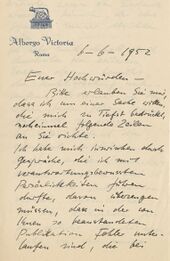
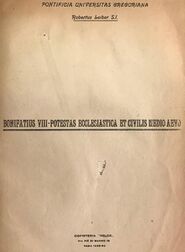
Nel 2025 è stato avviato un progetto in collaborazione con l'Holocaust Memorial Museum di Washington che ha previsto l'integrale digitalizzazione di una prima sezione del Fondo Leiber.
Questa documentazione è composta da corrispondenza, articoli di giornale, relazioni, annotazioni manoscritte e bozze suddivisa in 732 cartelle ordinate alfabeticamente comprendenti circa 3.500 documenti per un totale di quasi 12.000 carte.
FORM per la creazione delle cartelle (Restricted use)
 |
Sino alla conclusione del progetto è sospesa la consultazione e la richiesta di riproduzione da parte dei ricercatori. Nel caso in cui si voglia partecipare, singolarmente o con il proprio ente di ricerca, si prega di sottoporre a valutazione il proprio progetto compilando la richiesta. |
| Documents | Bibliography | |
|---|---|---|
|
|
|
Project Stages
- Conditioning and Conservation
Assessment of the state of conservation of the Fund's documents in order to intervene with targeted restoration, starting with the papers in a precarious state. The main damage is mechanical: tears, gaps and breaks in the edges of the papers.The documents, once numbered, will be cleaned using a dust collector, then interleaved and placed in conservation folders.
- The online epistolary
The digitized letters will be accompanied by metadata, which includes, in addition to the classical correspondence data, the key concepts and abstracts in English. On the GATE platform, it is possible to semantically annotate (planned entities: Names, Places, Works, Concepts) the texts, increasing the possibility of linking information and knowledge of a documentation that opens up a glimpse into the history of the Church in the 20th century. The letters of some correspondents (cf. the letters of Albrecht von Bayern) were used during seminars and teaching courses.
- Document Inventory
All the other material in the Fund will be described by means of an analytical inventory accessible online. Only part of these documents, selected by the APUG, may be digitized.
Copyrights
Unless otherwise indicated, all files and contributions (transcriptions, pages, comments) uploaded and submitted to GATE by administrators and users are considered to be released under the Creative Commons Attribution-NonCommercial-NoDerivatives 4.0 International License. All the rights on the images of the manuscripts or other documentation are property of the Historical Archives of the Pontifical Gregorian University (User:ArchivesPUG). If you need high resolution images for your publications or for other usages, please contact us using this form.
Your contributions to GATE must be original or, at most, copied from public domain or similar free sources. Remember to always cite your sources and, more important, do not submit copyrighted work without permission.
L’intenzione dell’APUG è mettere a disposizione dei ricercatori la documentazione del Fondo Leiber procedendo alla digitalizzazione e metadatazione di tutte le cartelle e, posteriormente, alla trascrizione e annotazione di tutti i documenti
Consistenza del fondo
A seguito di un preliminare inventario è stato possibile risalire al modo in cui il materiale è stato ordinato presumibilmente dallo stesso Leiber.
La corrispondenza del Fondo Leiber è conservata principalmente nei 14 faldoni ordinati alfabeticamente corrispondenza comprendenti a circa 3.000 documenti per un totale di quasi 8.000 carte.
Il resto del fondo ancora praticamente inesplorato, composto di un'altra decina di faldoni, si costituisce di appunti per le lezioni, bozze per articoli o conferenze, annotazioni bibliografiche, ritagli di giornale e estratti di rivista. Nel faldone XIX si segnalano i Registri delle lettere dal 1945 al 1967.
Gran parte di questi documenti presenta annotazioni manoscritte anche successive che testimoniano come questa documentazione sia stata un materiale di lavoro sul quale intervenire costantemente.
I documenti coprono un arco cronologico che va dagli inizi degli Anni Venti fino alla morte.
Dal punto di vista materiale si tratta di manoscritti, dattiloscritti (spesso stenografati) e stampati. Sono presenti pochissime fotografie o materiali in supporti diversi da quello cartaceo.
Fasi del progetto
- Condizionamento e conservazione.
Dalla valutazione dello stato di conservazione dei documenti nella corrispondenza del Fondo è emersa la necessità di intervenire sui danni riscontrati, principalmente di tipo meccanico: strappi, lacune e rotture dei bordi delle carte.
I documenti una volta numerati, sono stati puliti tramite pulitura manuale o in depolveratore, succesivamente restaurati, interfoliati e inseriti in cartelline conservative.
- L'epistolario on line
I documenti digitalizzati, sono accompagnate dalla metadatazione che prevede la descrizone del contenuto di tutte le cartelle corredato di schede analitiche per tutte le persone in relazione con i documenti.
- ↑ Catholic priest of the Diocese of Trier, canon lawyer, and professor of canon law; leader of the Centre Party (Germany) during the final years of the Weimar Republic. After 1933, he moved to Rome, where he became one of the closest collaborators of Eugenio Pacelli, first during Pacelli’s tenure as Secretary of State and later throughout his pontificate as Pope Pius XII. From 1936 onward, he served as bursar and administrator of Saint Peter’s Basilica, overseeing major restoration projects and the archaeological excavations beneath the basilica that led to the discovery of the Vatican necropolis. Georg May, Ludwig Kaas. Der Priester, der Politiker und der Gelehrte aus der Schule von Ulrich Stutz, 3 voll., Amsterdam, Grüner, 1981–1982.
- ↑ Much of the biographical information presented here is drawn from two sources: the commemorative article Ein unbedankter Diener ("An Unthanked Servant") by Mario von Galli SJ, published in Orientierung, n. 4, vol. 31, 28 February 1967, and a biographical note by Dr. Rita Haub, then Director of the Archive of the German Jesuit Province in Munich.